
Skardu & Deosai Travel Guide
Deosai National Park Jeep Safari Guide
A complete 2026 guide to Deosai National Park — best time to visit, jeep safari routes, vehicle choices, wildlife, costs, safety tips, family travel and what to realistically expect on the high-altitude plateau.
Why Deosai Feels Different From Every Other Skardu Trip
There are places in northern Pakistan that impress you instantly. Hunza hits you with peaks and viewpoints. Skardu gives you lakes and dramatic valleys. Fairy Meadows makes you feel like you stepped into a postcard. Deosai does something different.
Deosai is quieter, slower and more spacious. It does not perform for visitors. It does not try to impress you with a single viewpoint or one famous photo angle. It waits. If you give it time, it changes the way you feel.
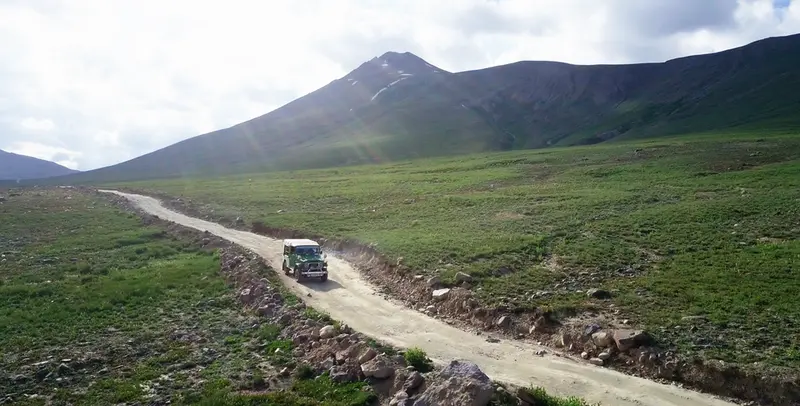
The climb usually begins with a mix of greenery, dust, sharp turns and a few stops. Then the trees begin to thin out. The air becomes sharper. The road feels rougher. Your ears pop. The world opens. Suddenly, you are not in a valley or beside a lake surrounded by shops. You are on a vast high-altitude plateau where the horizon feels almost too far away.
This is Deosai National Park, often called the Land of Giants — one of Pakistan’s most unusual and unforgettable landscapes.
It is not a casual stop. It asks for your day, your patience and your planning. In return, it offers something many modern destinations cannot: silence, scale and perspective.
Quick Safari Snapshot
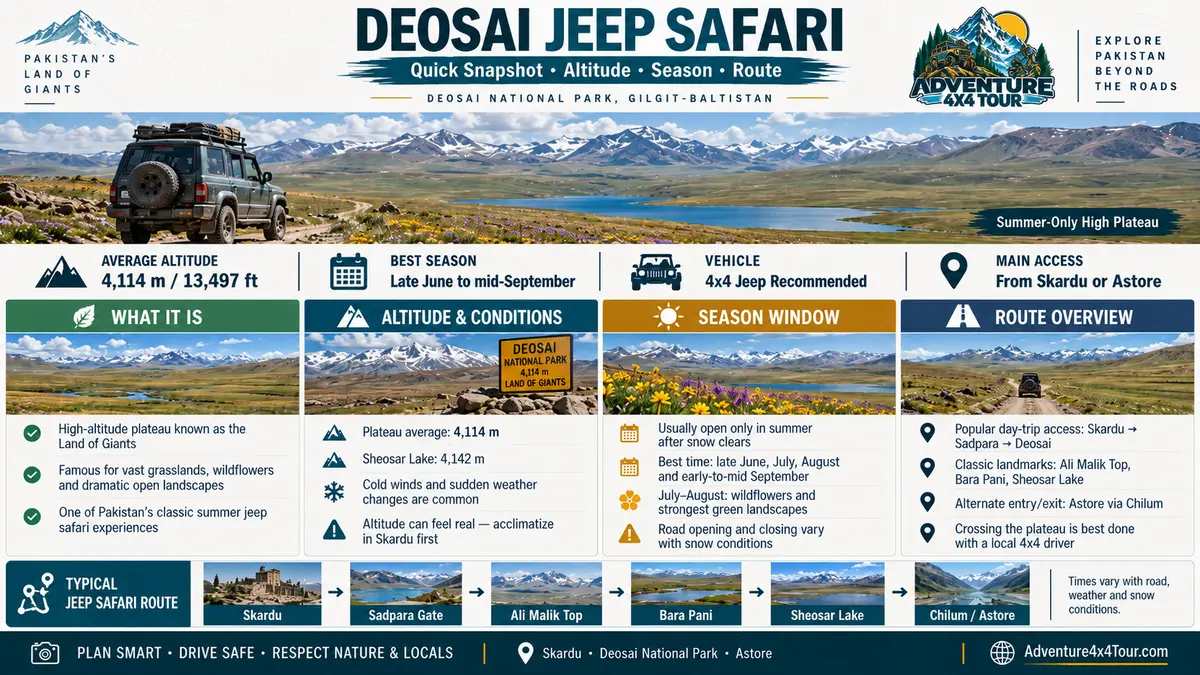
Deosai Jeep Safari in 60 Seconds
Use this quick overview before planning your Deosai National Park day trip, jeep route or camping extension.
Best Time
Late June to early September. July is the strongest all-round month for first-time visitors.
Altitude
Average elevation is around 4,100 meters, so altitude awareness is essential.
Vehicle
A proper 4x4 jeep is mandatory. Normal cars, hatchbacks and soft-road SUVs should not attempt Deosai.
Main Access
Skardu is the most popular route. Astore is often smoother and works well for Gilgit-side itineraries.
Top Experience
Jeep safari, Sheosar Lake, marmots, wide plains, wildflowers, sky watching and silence.
Trip Style
Best planned as a full-day safari, not a rushed half-day sightseeing stop.
- What Deosai National Park is famous for
- Where Deosai is located
- Best time to visit Deosai
- Why Deosai is closed in winter
- Is Deosai worth visiting?
- Jeep safari vs canter safari
- Skardu route vs Astore route
- Wildlife in Deosai National Park
- What you actually do in Deosai
- Deosai jeep safari cost in 2026
- Travel tips that actually matter
- Is Deosai safe for families?
- Nearby attractions to combine with Deosai
- Common mistakes that ruin Deosai trips
- Recommended Skardu & Deosai tour options
- FAQs
What Is Deosai National Park Famous For?
A High-Altitude World That Feels Unlike Pakistan’s Valleys
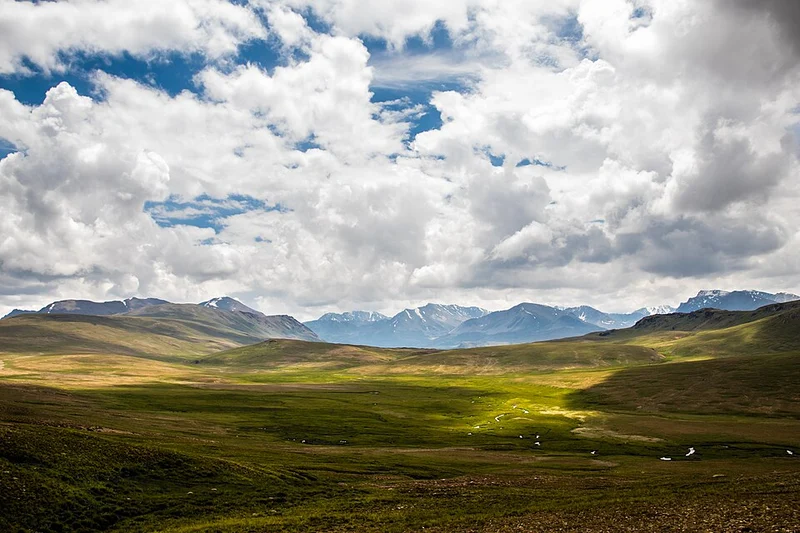
Deosai is famous because the whole place feels like a different planet. It is not built around a single landmark, bazaar, waterfall or viewpoint. Its power comes from the scale of the plateau itself.
At an average altitude of about 4,100 meters, Deosai behaves differently from lower valleys. The travel season is short, weather shifts quickly, normal vehicles struggle, and even fit travelers can feel the altitude.
Many travelers misunderstand Deosai before they arrive. They imagine a big meadow near Skardu or a quick green field that can be visited casually. But Deosai is not about mountains standing above you. It is about space. The plains stretch in every direction. You do not feel surrounded; you feel exposed.
For a few weeks, usually around July into early August, Deosai may bloom with wildflowers. Yellow, purple, white and blue flowers appear across parts of the plateau, depending on winter snow, melt timing, rainfall and temperature. The bloom is not guaranteed like a festival, but when it happens, it is unforgettable.
Deosai is also one of Pakistan’s most important places for Himalayan brown bear conservation. But it is not a zoo. Wildlife is not fed, controlled or scheduled. You may see marmots everywhere, birds of prey above the plains and perhaps distant wildlife if you are quiet and patient. A brown bear sighting is possible, but never guaranteed.
Land of Giants
The nickname fits because Deosai feels enormous. The sky, wind, grasslands and horizon create a scale that is hard to capture in photos.
Short Summer Bloom
Wildflowers usually appear during the strongest summer window, but timing depends on snowfall, meltwater, rainfall and temperature.
Protected Wildlife
Deosai is known for Himalayan brown bear conservation, marmots, birds of prey and a fragile high-altitude ecosystem.
Where Is Deosai National Park Located?
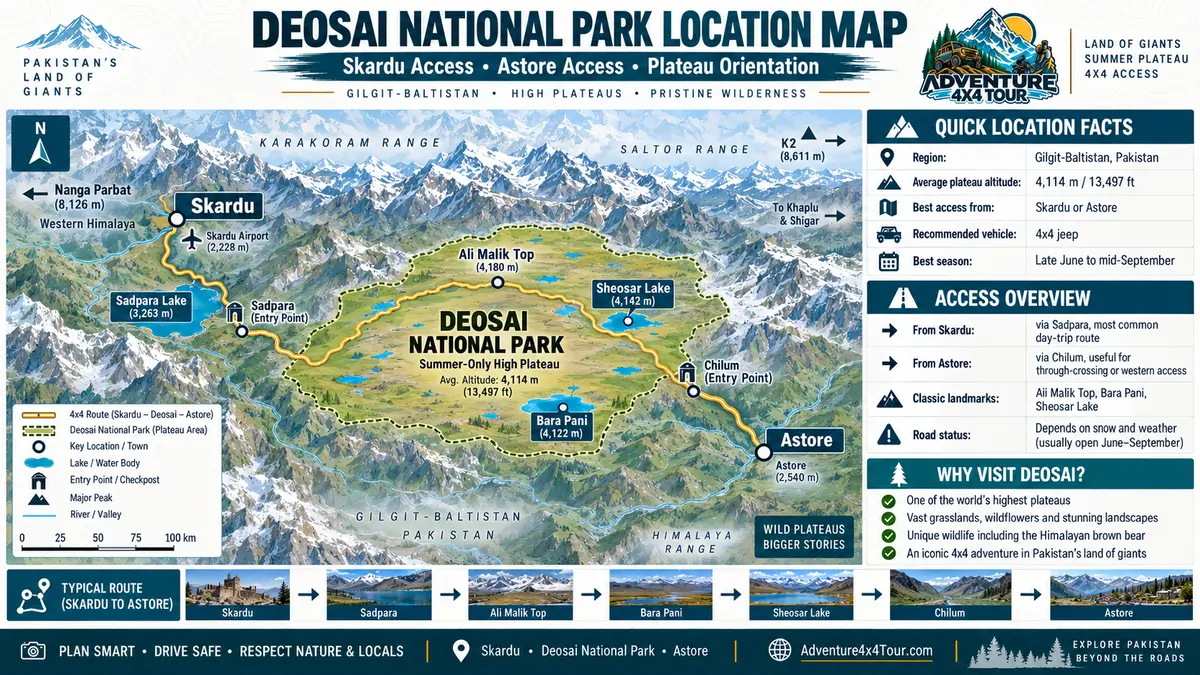
Deosai sits in Gilgit-Baltistan between two major access regions: Skardu and Astore Valley. This is why travelers often debate whether Deosai is a Skardu destination or an Astore destination.
The truth is that both routes work, but they offer different experiences.
Deosai from Skardu
- Most popular route for first-time visitors.
- Easy to combine with Skardu city, Sadpara Lake, Shigar and Khaplu.
- Rough, scenic and convenient for standard Deosai day trips.
- Travel time is usually 2.5 to 4 hours one way, depending on conditions.
Deosai from Astore
- Preferred by travelers coming from the Gilgit side.
- Often feels smoother and steadier than the Skardu approach.
- Works well for loop itineraries toward Astore, Rama and Minimarg.
- Travel time is usually 3 to 4 hours one way, depending on the route.
Best Time to Visit Deosai National Park
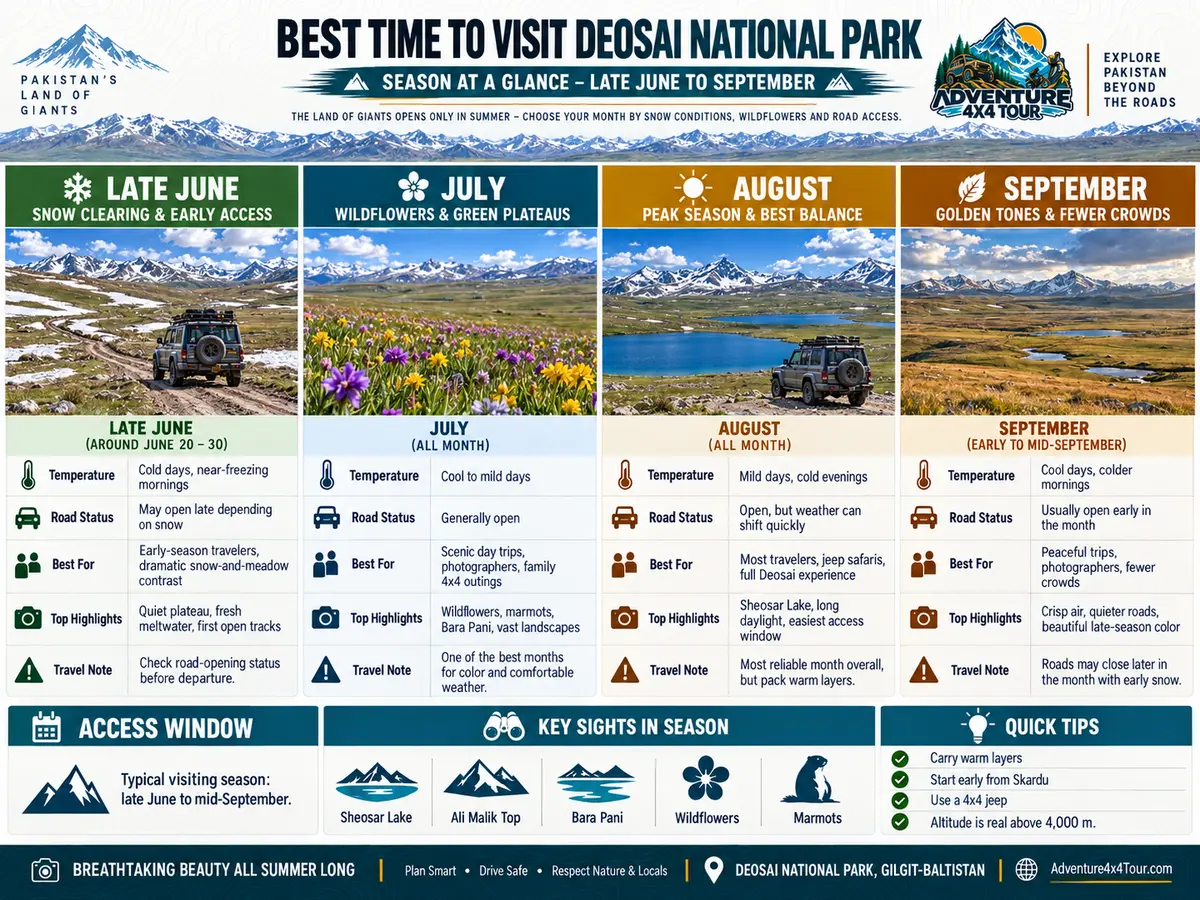
Deosai is season-bound. It does not offer the flexibility of lower valleys. The realistic visiting window is late June to early September.
Opening Phase
Deosai begins to open cautiously. Snow patches may remain, rivers can be stronger from meltwater and the plateau feels rugged and raw.
Peak Experience
July is the best all-round month. Wildflowers appear in many sections, marmots are active and the plateau feels alive.
Moody & Accessible
August keeps Deosai open, but afternoon clouds, rain, hail and muddy tracks are more likely.
Quiet & Golden
Flowers fade, grass turns gold, the air becomes sharper and tourist numbers drop.
Why Deosai Is Closed in Winter
Travelers ask every year whether Deosai can be visited in winter, in October, with snow chains or with a very strong vehicle. The honest answer is simple: winter Deosai is not a tourism experience. It is isolation.
Deosai sits above 4,000 meters. In winter, snow piles up several feet deep, tracks disappear completely, visibility drops quickly during storms, and there are no permanent settlements inside the park. This is not like visiting a snowy hill station. It is a high-altitude plateau that turns into a sealed world.
The roads are not maintained for winter tourism, there is no regular emergency system inside the park, and experienced local drivers avoid crossings because they understand the risk. Conservation also matters. Winter is survival season for wildlife, and human interference can disrupt feeding patterns, increase stress and damage habitat.
Do Not Attempt Winter Deosai If
- You are expecting sightseeing, snow photos or a casual winter adventure.
- You are relying on a normal vehicle or a driver without Deosai experience.
- You have children, elderly travelers or anyone sensitive to altitude.
- You do not have rescue support, local guidance and proper winter expedition planning.
Important Reality
- Deosai roads are not regular winter tourist routes.
- Tracks disappear under snow and are not cleared like city roads.
- Weather can change faster than any itinerary can adjust.
- Winter closure protects both travelers and the ecosystem.
Is Deosai Worth Visiting?
Yes — Deosai is worth visiting, but only for the right kind of traveler.
The problem is that many people compare it with places that offer instant drama: Fairy Meadows, Khunjerab, Skardu lakes or Hunza viewpoints. Deosai gives a different reward.
Deosai Is Worth It If You Want
- Uncrowded wilderness, even in peak season.
- Raw nature that has not been packaged into selfie points.
- A jeep safari where the journey itself is the main experience.
- Wide horizons, silence, wind and a feeling of mental reset.
- Minimalist landscapes rather than immediate spectacle.
Deosai May Disappoint If You Expect
- Restaurants, restrooms, shops and comfort-focused tourism.
- Guaranteed wildlife sightings, especially brown bears.
- A short and easy half-day trip with no fatigue.
- Entertainment, crowds, cafés or constant visual stimulation.
- A destination that performs instantly from one photo angle.
Jeep Safari vs Canter Safari: What Actually Works?
Your Vehicle Decides Your Experience
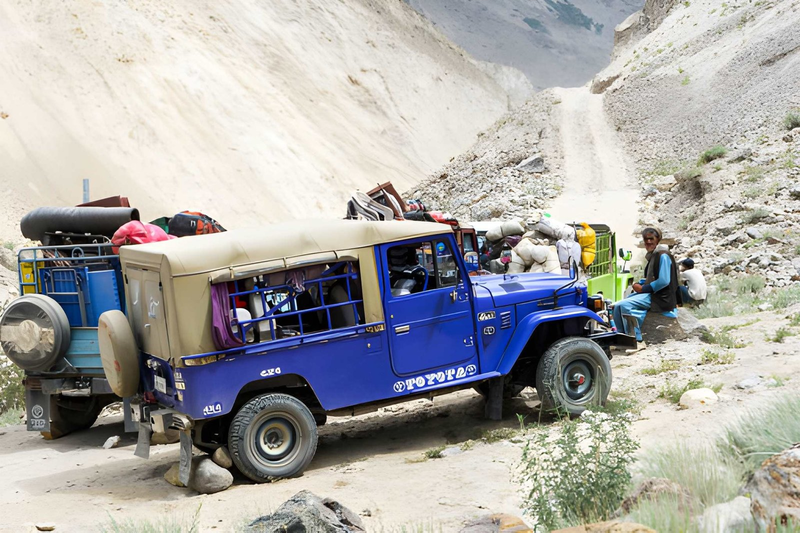
Transport is not a background detail in Deosai. It is the spine of the journey. Choose the right vehicle and the plateau opens itself to you. Choose the wrong one and the same landscape becomes stressful, slow and occasionally risky.
A jeep safari is not about status or luxury. It is about capability. Deosai has narrow dirt tracks, stream crossings, mud after rain, uneven alpine ground and stretches where the route is understood by local drivers more than by maps.
Canter-style safari vehicles belong in parks with wide, flat and predictable tracks. Deosai is not that kind of terrain. Canters are too wide for many tracks, less maneuverable at crossings and less suitable on uneven ground.
If someone offers a “canter safari” for Deosai, treat it as a warning sign rather than a creative option.
Toyota Land Cruiser
Stable, reliable, strong ground clearance and trusted by local drivers. Best for families and first-time visitors.
Toyota Prado
Capable and more comfortable for couples, small groups and photographers who want frequent stops.
Local 4x4 Jeep
Older, louder and extremely capable when driven by someone who knows Deosai’s streams, soft ground and weather patterns.
Normal Cars
Sedans, hatchbacks, 2WD crossovers and soft-road SUVs should not attempt Deosai, even in good weather.
Skardu Route vs Astore Route
There is no universal better route. There is only the route that suits your starting point, comfort level, time and wider itinerary.
| Route | Best For | Travel Feel | Main Advantage |
|---|---|---|---|
| Skardu to Deosai | First-time visitors based in Skardu | Rough, scenic and popular | Easy to combine with Skardu sightseeing and accommodation |
| Astore to Deosai | Travelers coming from Gilgit side | Smoother and steadier | Less stressful drive and good for loop itineraries |
| Skardu → Deosai → Astore | Experienced travelers with time | Long but rewarding | Gives the full crossing experience if weather and timing allow |
| Skardu → Deosai → Skardu | Standard private day trip | Full-day jeep safari | Most convenient and easiest to arrange |
Best for Most Skardu Travelers
Skardu to Deosai and back to Skardu is the simplest day safari route because hotels, drivers and local logistics are easiest to arrange.
Best for Loop Itineraries
The Astore side works well if you are connecting Skardu with Gilgit, Rama, Minimarg or a wider northern Pakistan road route.
Best Safety Rule
Do not decide the route only from maps. Same-day weather, driver advice and road condition matter more than planned distance.
Wildlife in Deosai National Park
Deosai is one of Pakistan’s most important protected landscapes because it allows wildlife to exist without performance.
Animals here are not fenced, fed or conditioned for humans. You are a guest. Nothing comes to you on schedule.
Wildlife Is Not Guaranteed
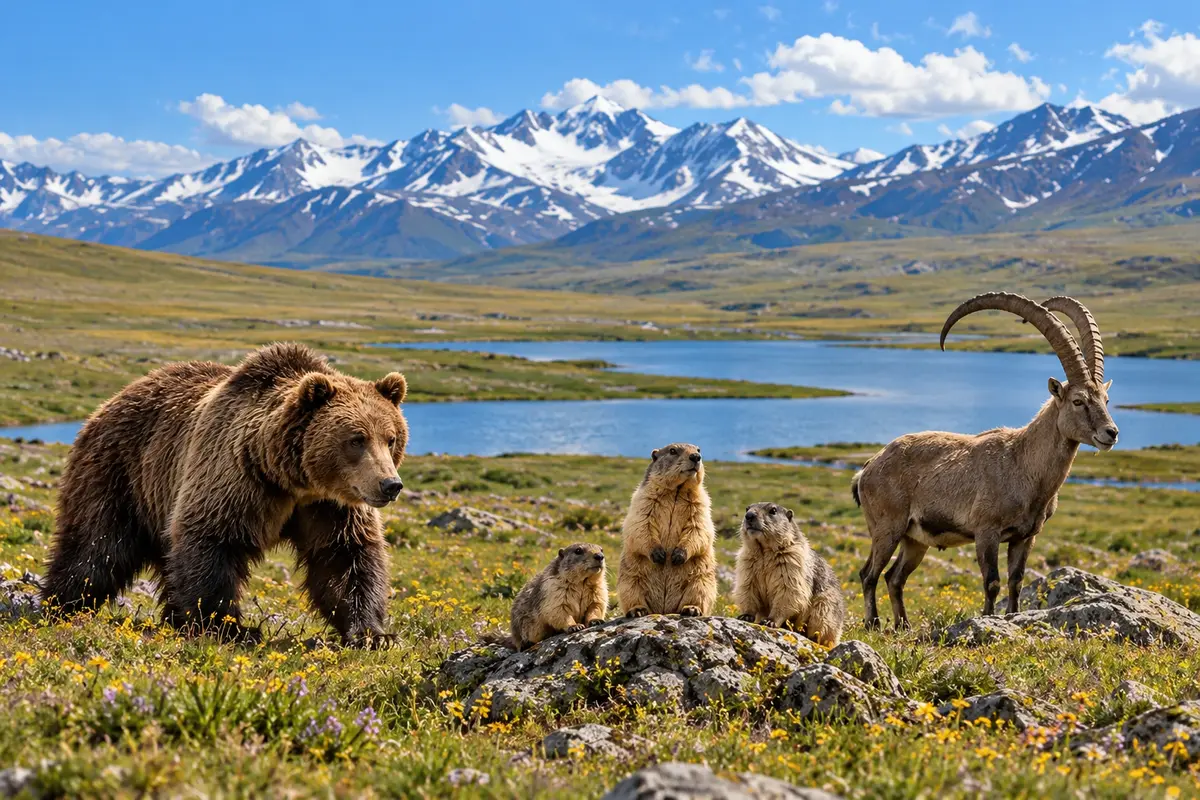
Deosai is famous for the Himalayan brown bear, but brown bear sightings are never guaranteed. Marmots are the wildlife most casual visitors usually see.
For better wildlife chances, move quietly, keep distance, avoid loud music and let your driver choose safe stopping points.
Himalayan Brown Bear
Deosai is famous for the Himalayan brown bear and hosts Pakistan’s most stable population. Sightings depend on time of year, time of day, distance from busy tracks and luck.
Marmots
Marmots are the everyday residents most visitors actually see. They are active, vocal and constantly popping in and out of burrows across the plains.
Other Mammals
Tibetan wolf, red fox and mountain weasel also live in the ecosystem, but they are shy and rarely visible to casual visitors.
Birdlife
Golden eagles, Himalayan griffon vultures and snow partridges make Deosai quietly rewarding for birdwatchers, especially in early summer.
Responsible Wildlife Travel
- Stay on existing tracks and avoid disturbing habitat.
- Observe wildlife from a distance.
- Let your driver guide stopping points and safe behavior.
- Keep noise low and scan slowly instead of chasing sightings.
Never Do This
- Do not feed animals.
- Do not approach bears, marmots or nests for photos.
- Do not drive off-track to get closer to wildlife.
- Do not treat Deosai like a zoo or staged safari park.
What You Actually Do in Deosai
Deosai is not activity-heavy. It does not reward checklists. It rewards presence. The best way to experience it is to slow down, stop often and let the landscape work on you.
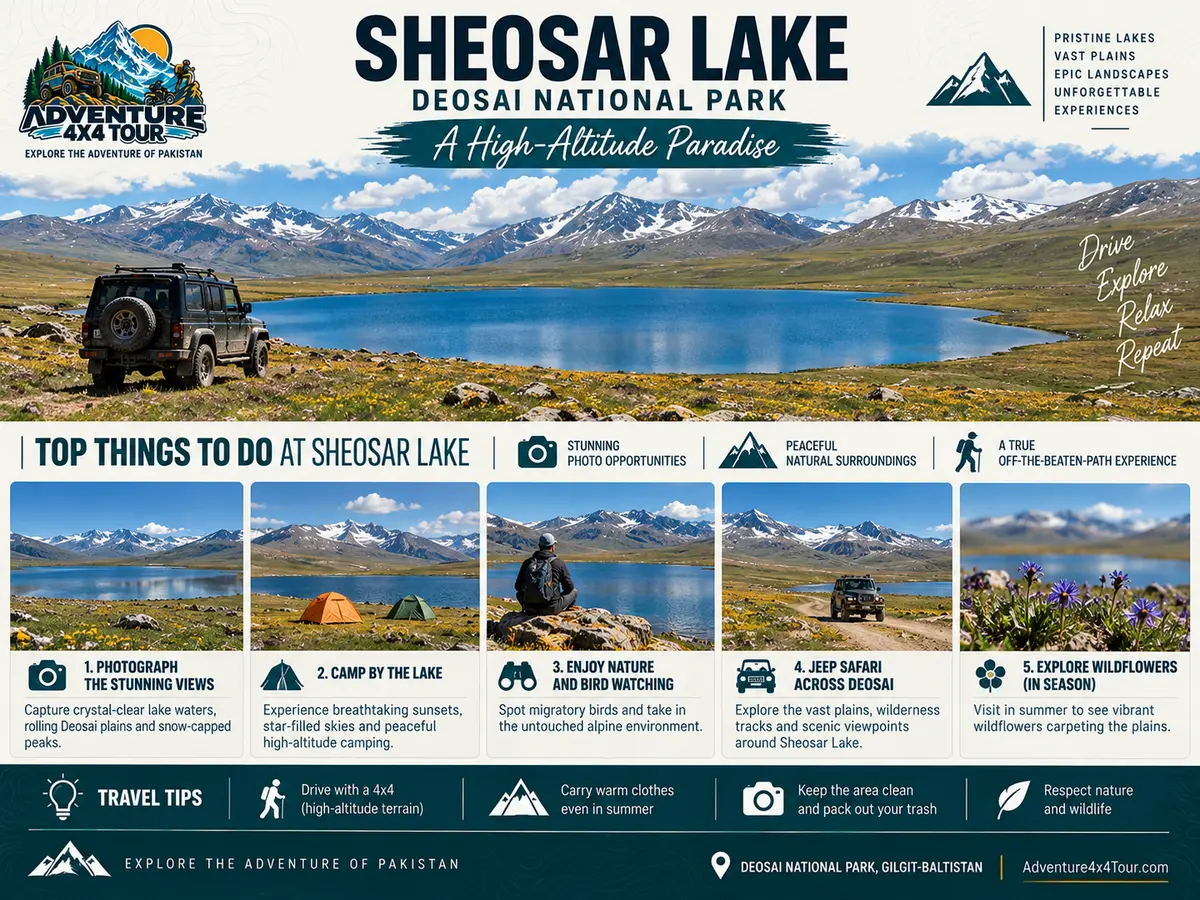
Sheosar Lake
The visual anchor of Deosai: clear water, open plains and distant peaks on clear days.
Wildlife Spotting
Stop the jeep, sit quietly and scan slowly. Marmots are common; bears require luck and patience.
Photography
Massive skies, long horizons, shifting clouds and minimal visual clutter make Deosai ideal for wide compositions.
Sky Watching
If you stay late or camp, light pollution is minimal and the night sky can feel unusually close.
Camping
Powerful but demanding. Freezing nights, wind and basic facilities make it suitable only with proper gear and guidance.
Doing Less
The real Deosai experience is not rushing. It is stopping, listening and letting the plateau feel bigger than your plan.
Deosai Jeep Safari Cost in 2026
Deosai pricing is remote logistics pricing, not luxury pricing. You are paying for vehicle wear at high altitude, fuel consumption, driver expertise, isolation and self-reliance.
| Cost Item | Estimated Range | Notes |
|---|---|---|
| Jeep rental from Skardu | PKR 18,000 – 25,000 per day | Varies by season, vehicle type and route length. |
| Jeep rental from Astore | PKR 16,000 – 22,000 per day | Usually depends on local availability and route plan. |
| Fuel cost | PKR 5,000 – 8,000 average | Fuel up before entering; there are no reliable options inside the park. |
| Guide | PKR 3,000 – 5,000 | Optional, but useful for wildlife, camping and deeper interpretation. |
| Total private day trip | PKR 25,000 – 35,000 total | Reasonable when split among 1–5 travelers. |
Why It Costs More Than a City Transfer
Deosai involves high-altitude fuel use, rough tracks, stream crossings, vehicle wear and driver skill that normal sightseeing routes do not require.
Best Cost Strategy
Split a private 4x4 among 3–5 travelers when possible, but do not choose the cheapest vehicle if it lacks capability or a trusted driver.
Carry Cash
Remote jeep routes, entry points and small local arrangements usually depend on cash rather than card payments or online transfers.
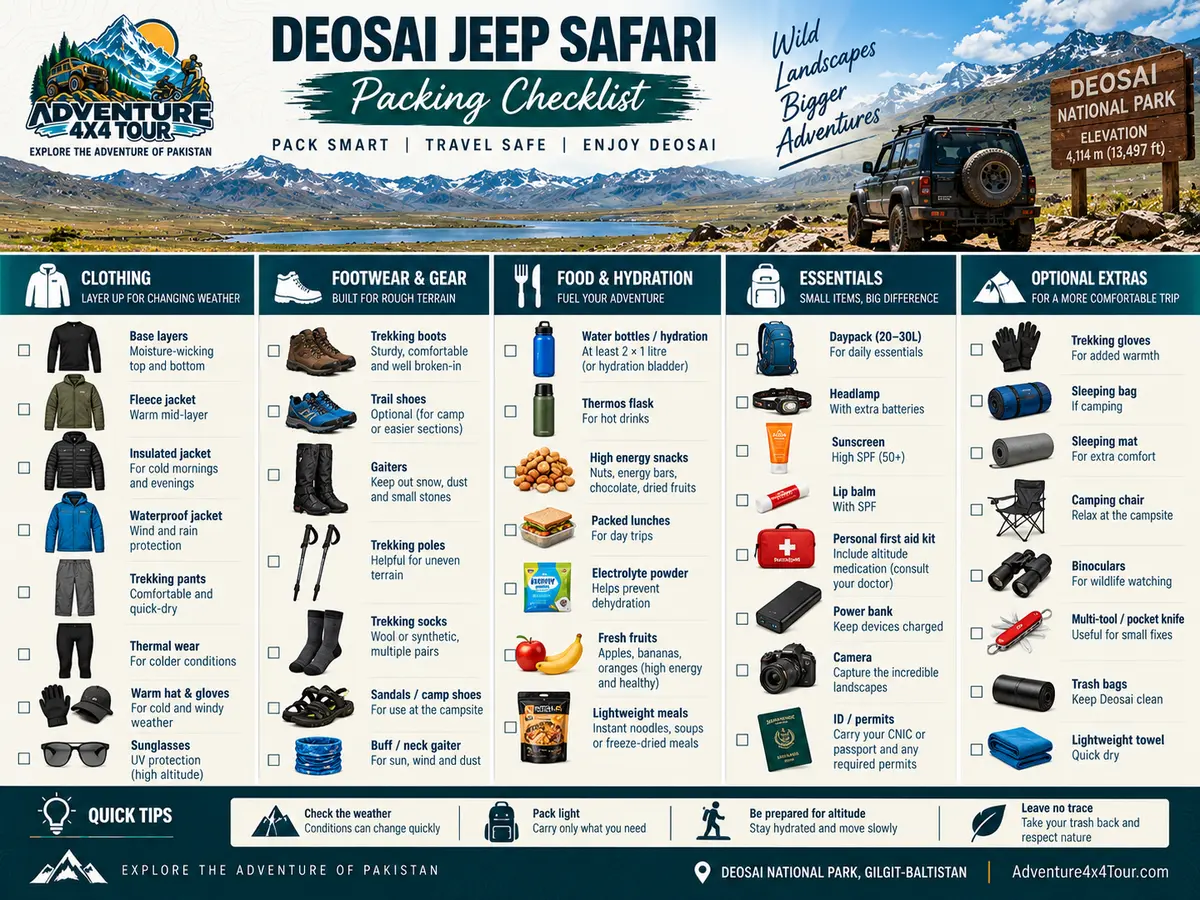
Travel Tips That Actually Matter
Altitude Awareness
- Spend at least one night in Skardu or Astore before visiting.
- Hydrate constantly, even when you do not feel thirsty.
- Eat light and avoid overexertion on the plateau.
- If symptoms intensify, the solution is descent, not stubbornness.
Weather Reality
- Start early in the morning.
- Carry warm layers even in July.
- Pack rain protection and wind protection.
- Plan to exit before late evening.
Facilities Reality
- No restaurants inside.
- No reliable mobile network.
- No shops or medical facilities.
- No comfort-focused infrastructure once you are deep inside the park.
Is Deosai Safe for Families?
Deosai can work for families, but only with realistic planning.
It is better suited to older children who can handle a long jeep ride, cold wind, limited facilities and a quiet landscape. For toddlers, elderly travelers sensitive to altitude or families needing frequent comfort stops, Deosai can become tiring quickly.
Family Trip Works If
- Children are older and comfortable with long drives.
- The visit is a day safari, not overnight camping.
- You use a reliable 4x4 with an experienced local driver.
- Weather is stable and the itinerary is not rushed.
Consider Skipping If
- You are traveling with toddlers.
- Someone in the group is altitude-sensitive.
- You need frequent restrooms or easy food stops.
- Your Skardu schedule has no buffer time.
Nearby Attractions to Combine With Deosai
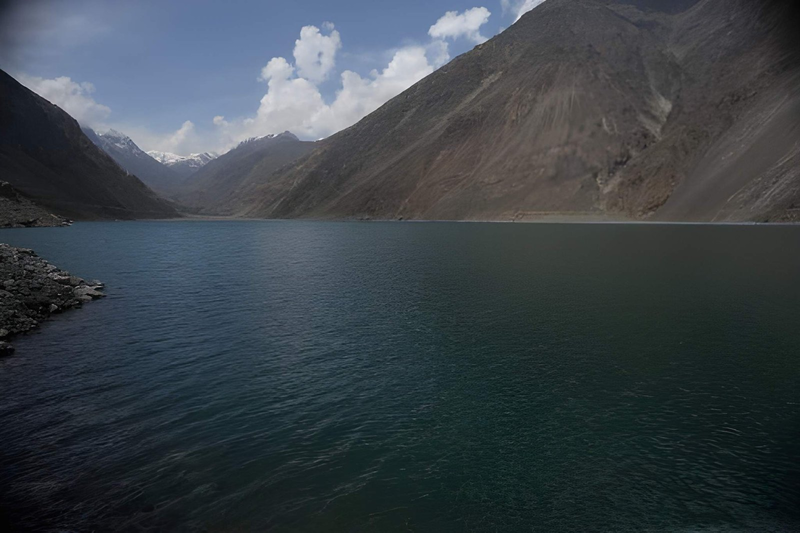
Sadpara Lake, Astore and Minimarg
Sadpara Lake is the easiest and most rewarding add-on from the Skardu side. It sits close to Skardu and pairs beautifully with a Deosai day, especially at sunrise or sunset.
Astore Valley works well as an exit strategy if you are crossing Deosai rather than returning to Skardu. After Deosai’s openness, Astore feels greener, sheltered and gentler.
Minimarg is only for extended trips. It requires permits, local guidance and flexible timing, but rewards experienced travelers with alpine beauty and deep remoteness.
Common Mistakes That Ruin Deosai Trips
Avoid These Mistakes
- Treating Deosai as a quick stop instead of a full-day experience.
- Starting late and reaching the plateau in unstable afternoon weather.
- Underestimating cold, wind and altitude.
- Choosing a vehicle based only on price instead of capability.
- Expecting cafés, restrooms, entertainment or guaranteed wildlife.
Do This Instead
- Start early and keep the day flexible.
- Use a proper 4x4 and an experienced local driver.
- Pack water, snacks, warm layers and rain protection.
- Stop often and let the plateau feel spacious.
- Respect wildlife, tracks and conservation rules.
Recommended Skardu & Deosai Tour Options
These trip styles work best for travelers who want Deosai included inside a realistic Skardu or northern Pakistan itinerary with proper jeep planning, weather awareness and experienced drivers.
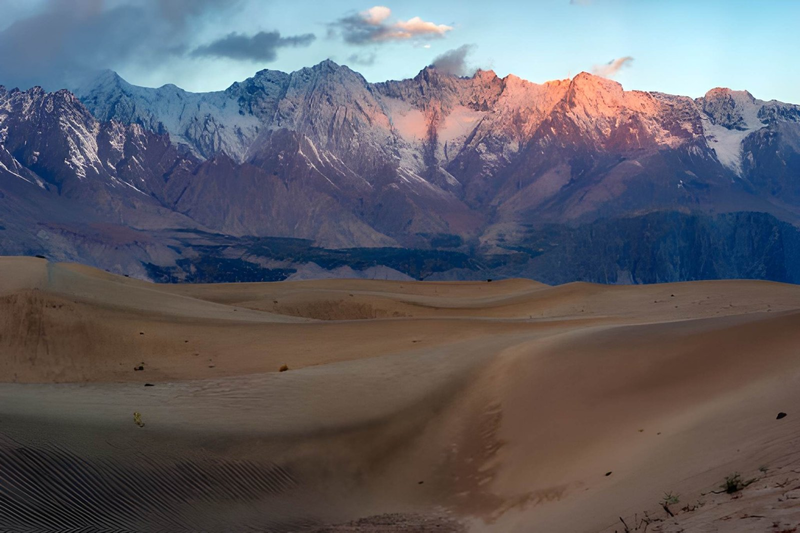
Custom Deosai Jeep Safari
A private Deosai day trip built around the right vehicle, early start, route conditions and realistic time on the plateau.
Customize Tour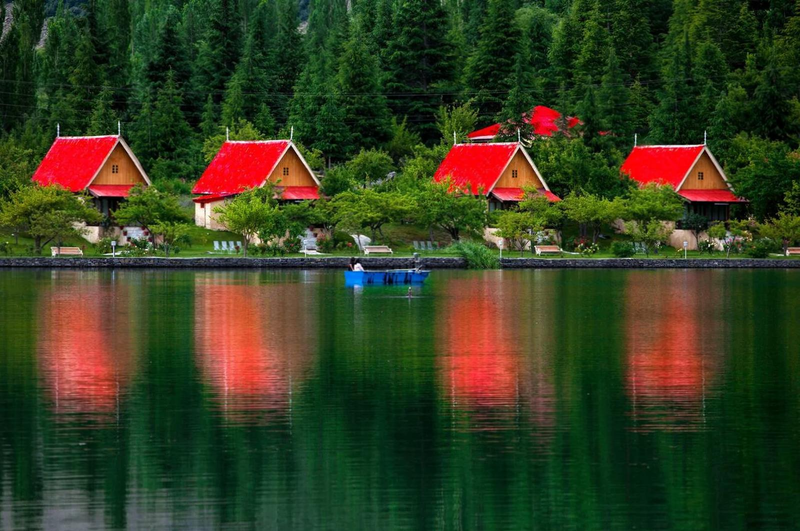
Skardu Valley Tour Packages
A wider Skardu itinerary combining lakes, forts, Shigar, Khaplu and Deosai when the season is right.
View Tours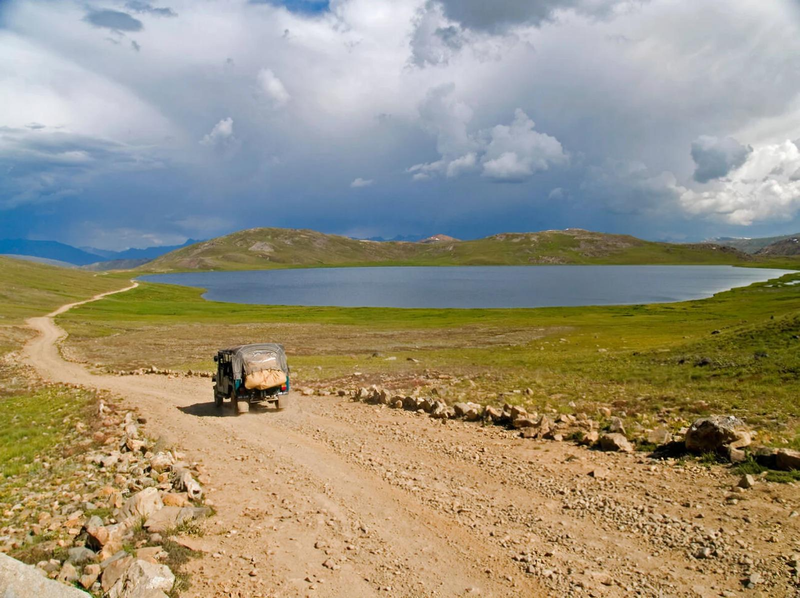
Astore to Deosai Crossing
A route-focused itinerary for travelers who want the smoother Astore approach or a Skardu–Deosai–Astore loop.
Plan RouteFAQs About Deosai National Park Jeep Safari
Is Deosai open all year?
No. Deosai is accessible only from late June to early September, depending on snow conditions. Outside this window, regular tourism is not recommended because tracks disappear and rescue becomes extremely difficult.
Do we need special permits for Deosai?
Standard visitors generally do not need a special permit. Entry fees are usually paid at the park gate. Special routes or extended areas may require local guidance and updated checks.
Can we visit Deosai without a jeep?
No. A proper 4x4 jeep is mandatory for a safe and realistic Deosai visit. Regular cars, hatchbacks and soft-road vehicles should not attempt the plateau.
Are brown bear sightings guaranteed?
No. Brown bears are rare and protected. Marmots are common, but bear sightings depend on season, time of day, distance from busy tracks and luck.
Is camping necessary to enjoy Deosai?
No. Most travelers experience Deosai fully through a day jeep safari. Camping can be powerful, but it requires proper gear, guidance and tolerance for cold nights and strong wind.
Is Deosai safe for families?
Yes, if children are older, the weather is stable, a reliable 4x4 is used and the trip is planned as a day safari. It is not ideal for toddlers or travelers highly sensitive to altitude.
Final Takeaway: Plan Deosai With Respect
Deosai rewards travelers who understand its limits: the right season, the right jeep, the right driver and the right pace.
It is not a place to rush, improvise casually or treat like a normal sightseeing stop. It is a remote high-altitude plateau where weather, altitude, road conditions and wildlife all matter.
Plan it carefully, and the plateau becomes one of the most memorable experiences in northern Pakistan — not because it entertains you, but because it makes you feel the scale of the land around you.
