
Swat Valley Travel Planning & Comparison Guide
Swat vs Hunza – Which Is Better for First-Time Travelers?
A complete first-time traveler comparison of Swat Valley and Hunza Valley, covering accessibility, distance, road comfort, seasons, landscapes, culture, cost, family travel, safety, itineraries and the honest question of which northern Pakistan destination you should choose first.
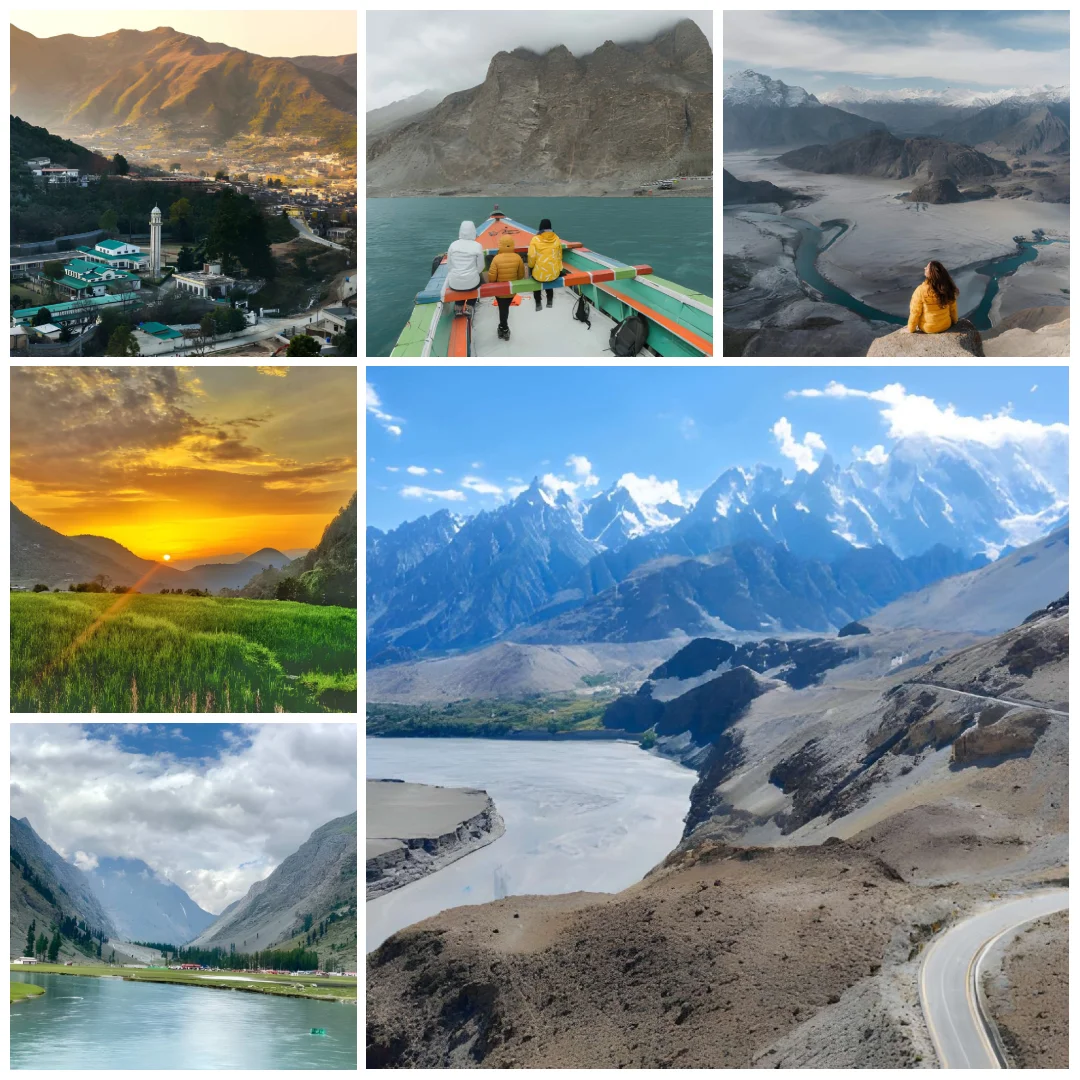
Swat vs Hunza: Which Valley Should You Visit First?
If you are planning your first trip to northern Pakistan, chances are you are stuck between two names that appear everywhere: Swat and Hunza.
Both are praised. Both are photographed endlessly. Both are described as paradise. And yet, they offer very different first-time travel experiences.
This guide is not about crowning a winner. It is about helping you choose the right valley for your first journey based on how you travel, how much time you have, how comfortable you are with long road journeys and what kind of memories you want to come back with.
Swat is often called the Switzerland of Pakistan — green, accessible and comforting. Hunza is known as the Land of Giants — dramatic, remote and awe-inspiring.
One feels welcoming immediately. The other feels unforgettable slowly.
For first-time travelers, that difference matters more than most people realize. A destination is not only scenery. It is the full experience: arrival, roads, hotels, meals, weather, fatigue, people, safety, cost and how easily the trip keeps moving when something changes.
Swat makes northern Pakistan feel approachable. Hunza makes northern Pakistan feel immense.
Neither is better for everyone. But one may be better for your first trip.
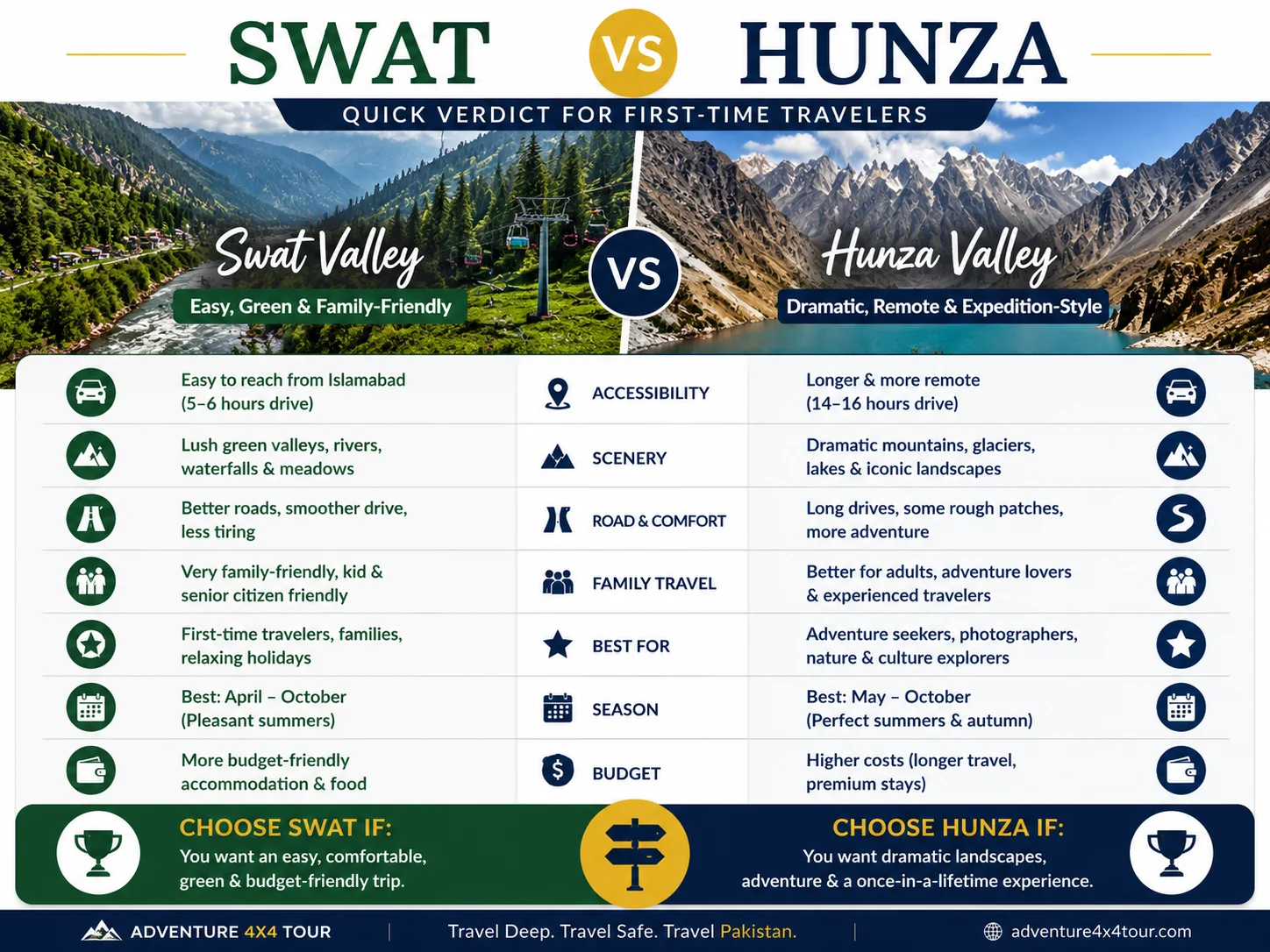
Quick Verdict
Swat vs Hunza at a Glance
Swat and Hunza are both iconic northern Pakistan destinations, but they suit different first-time travelers. Swat is easier, greener and more flexible. Hunza is grander, more remote and more demanding.
Best for First-Time Comfort
Swat is better for travelers who want short travel time, easy road access, familiar food, family comfort and flexible planning.
Best for Dramatic Scenery
Hunza is better for travelers who want huge mountains, glaciers, rocky landscapes and the emotional scale of the Karakoram.
Best for Families
Swat usually works better for children, parents and mixed-age groups because distances are shorter and services are easier to access.
Best for Adventure Depth
Hunza suits travelers who want a longer journey, glacier viewpoints, high-altitude drives and slower, more immersive travel.
Minimum Practical Time
Swat can feel satisfying in 3 to 4 days. Hunza usually needs at least 7 days to avoid feeling rushed.
Best Order
For many travelers, the ideal progression is Swat first, Hunza later, then return to both with clearer preferences.
- Pakistan’s two crown jewels of the north
- Where Swat and Hunza are located
- Accessibility, distance and travel comfort
- Best time to visit Swat vs Hunza
- Landscape and scenery comparison
- Culture, people and daily life
- Cost, accommodation and value
- Adventure, safety and infrastructure
- Sample first-time itineraries
- Final verdict
- FAQs
Pakistan’s Two Crown Jewels of the North
Swat and Hunza are often mentioned together, but geographically, culturally and emotionally, they are worlds apart.
Swat Valley lies in Khyber Pakhtunkhwa and has long been a favorite for domestic travelers because of its greenery, rivers, forests and easy access from Islamabad.
Hunza Valley sits deep in Gilgit-Baltistan along the Karakoram Highway, surrounded by some of the tallest mountains on earth.
Both are beautiful, but beauty expresses itself differently in each.
Swat impresses you gently.
Hunza overwhelms you.
For a first-time traveler, that distinction matters more than most people realize. Your first northern trip is not just about collecting famous places. It is about learning how you respond to mountain roads, altitude, local culture, long drives, remote hotels and shifting weather.
Swat gives you an easier introduction. Hunza gives you a more intense mountain education.
Where Are Swat and Hunza Located?
Understanding location is not just geography. It is about effort, comfort and travel fatigue.
Swat is located in northern Khyber Pakhtunkhwa, close enough to Islamabad that it can work as a short mountain escape. Hunza is located far north in Gilgit-Baltistan, deep along the Karakoram Highway, where the journey itself becomes part of the destination.
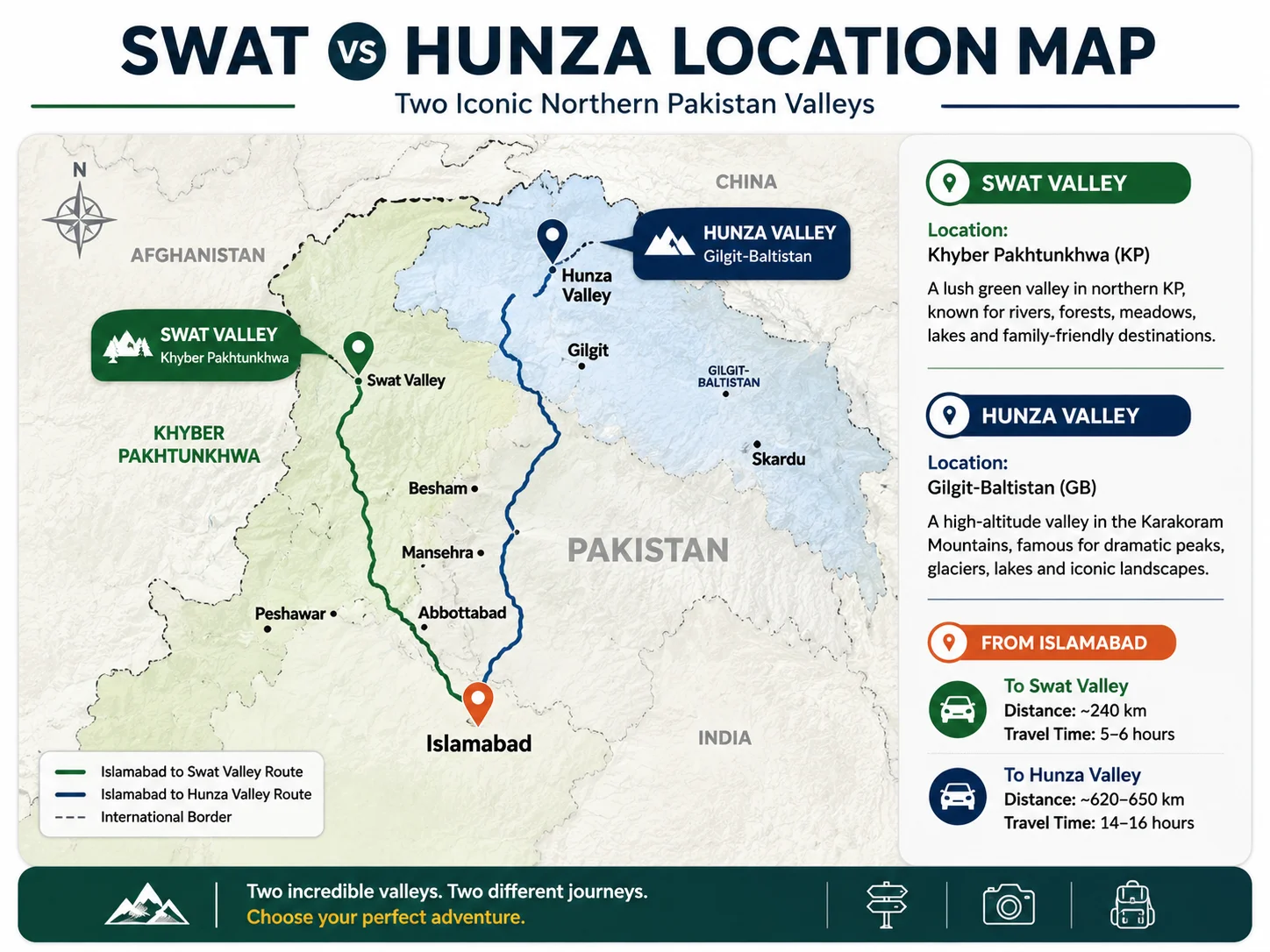
Swat feels close not only because of distance, but because the route is more predictable. The Swat Expressway connects the plains directly toward the valley, making Mingora, Malam Jabba, Bahrain and Kalam easier to plan.
Hunza feels remote because it is remote. You travel through long mountain corridors before reaching Karimabad, Gulmit, Passu, Attabad Lake and the broader Hunza route.
That distance is part of Hunza’s magic, but it also raises the commitment level for first-time travelers.
Swat – Gateway to Khyber Pakhtunkhwa
Swat Valley is reached from Islamabad through motorway connections and the Swat Expressway. Key towns include Mingora, Saidu Sharif, Malam Jabba, Madyan, Bahrain and Kalam.
For first-time travelers, Swat feels familiar quickly. Roads are straightforward, towns are lively and services are easy to find.
Hunza – Heart of Gilgit-Baltistan
Hunza Valley lies far north along the Karakoram Highway, beyond Gilgit and toward Karimabad, Gulmit, Passu and Khunjerab-side routes.
Hunza does not feel close to anywhere, and that is part of its appeal. But for first-time travelers, distance translates directly into planning complexity.
How to Reach: Accessibility, Distance and Travel Comfort
When first-time travelers compare Swat vs Hunza, the biggest difference does not show up in photos.
It shows up in how long you sit in a vehicle, how tired you feel when you arrive and how much energy you still have to explore.
This is where the two valleys diverge sharply.
Reaching Swat: Designed for Easy Entry
Swat Valley feels close, not just on a map, but in experience.
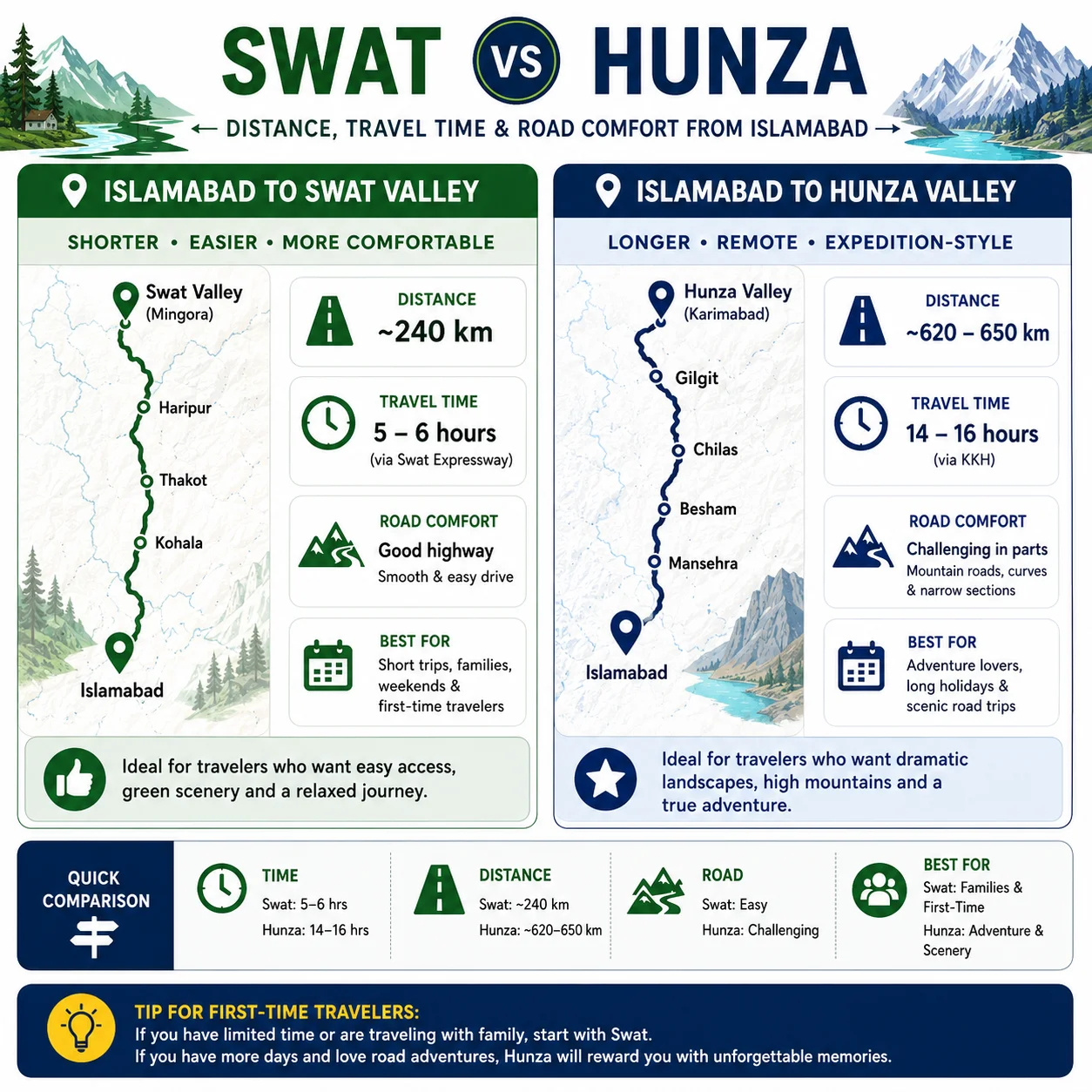
From Islamabad, the journey into Swat Valley is smooth and predictable thanks to the Swat Expressway. Road quality remains consistent, rest stops are frequent, and navigation is straightforward even for first-time drivers.
Most travelers reach Mingora within five to six hours, including short breaks. From there, popular destinations like Malam Jabba and Kalam are reached via paved mountain roads that gradually climb rather than shock the body.
The result is simple: you arrive in Swat feeling ready, not drained.
That matters for first-time travelers who want to explore immediately instead of recovering from the journey.
Reaching Hunza: A Journey Before the Destination
Hunza demands more, physically and mentally.
The drive from Islamabad to Hunza Valley usually takes between fifteen and eighteen hours, spread over at least two days if done comfortably. The route follows the Karakoram Highway, passing through Gilgit before reaching Karimabad.
The scenery is spectacular, but the drive is long, winding and mentally demanding. Altitude changes are sharper, and road conditions vary depending on weather and seasonal maintenance.
Flying to Gilgit reduces travel time, but flights are weather-dependent and can be delayed or cancelled. Even after landing, a mountain drive remains.
Hunza does not ease you in. It expects patience.
| Factor | Swat Valley | Hunza Valley | First-Time Reality |
|---|---|---|---|
| Distance from Islamabad | About 250–300 km | About 600–700 km | Swat is much easier for short trips |
| Typical Travel Time | 5–6 hours | 15–18 hours by road | Hunza needs more stamina and days |
| Road Quality | Modern expressway plus paved valley roads | Mountain highway with variable sections | Swat feels more predictable |
| Flight Option | Saidu Sharif when available | Gilgit, weather-dependent | Flights help but cannot be treated as guaranteed |
| First-Time Comfort | High | Moderate to low | Swat is more forgiving for beginners |
Seasonal Accessibility: A Crucial Difference
Swat remains accessible for most of the year. Even in winter, roads up to Mingora and Malam Jabba usually stay operational, with only upper routes affected by snowfall.
Hunza is more season-sensitive. Winter closures near high routes limit movement, and landslides or weather disruptions can affect plans unexpectedly.
For first-time travelers who want predictability, Swat offers more control.
Travel Fatigue and What It Means for Your Trip
In Swat, travel feels like a transition.
In Hunza, travel feels like a commitment.
Arriving tired does not ruin a trip, but it shapes how you experience the first two days. Swat allows you to settle in quickly. Hunza often asks you to rest first.
That difference alone pushes many first-time travelers toward Swat for their initial northern escape.
Best Time to Visit – Swat vs Hunza
Choosing between Swat Valley and Hunza Valley is not really about which valley is better.
It is about when you go, and whether that timing matches your energy, patience and expectations as a first-time traveler.
Seasonal advice online is often misleading because it treats valleys like static destinations. In reality, Swat and Hunza behave very differently across the year, not just in weather, but in accessibility, cost, crowd pressure and emotional experience.
For someone visiting northern Pakistan for the first time, season choice can quietly make or break the trip.
Spring: Ease vs Anticipation
Spring is where first-time travelers feel the biggest difference between Swat and Hunza.
In Swat, spring feels like a soft re-entry into the mountains. By late March, lower Swat is already green. Roads are clear, rivers are lively and towns like Mingora and Madyan feel active without being crowded.
You do not need perfect planning here. Even a loosely planned trip can work.
Hunza in spring is more complicated. Cherry blossoms are stunning, but they reward patience rather than convenience. Early spring travel to Hunza can involve weather uncertainty, limited mobility at higher elevations and the need to time blossom season carefully.
For first-timers, spring favors Swat strongly. Hunza is better saved for travelers who are comfortable adjusting plans.
Summer: Accessibility vs Spectacle
In Swat, June feels ideal. Temperatures are cool compared to the plains, waterfalls are active, and destinations like Malam Jabba and Kalam operate at full rhythm.
Peak summer brings crowds, but Swat absorbs them relatively well because multiple towns, short travel distances and flexible routes prevent congestion from dominating the experience.
Hunza in summer is visually unmatched: towering peaks, glacier-fed rivers and clear mountain skies. But it demands discipline. Long travel days, fixed hotel bookings and route dependencies leave less room for improvisation.
Swat lets you wander. Hunza asks you to commit.
September and Autumn: Calm vs Visual Drama
September is a turning point that many first-time travelers miss.
In Swat, September is underrated. Weather stabilizes, crowds begin thinning and the valley feels calmer without losing accessibility. This is an excellent month for first-time travelers who want beauty without pressure.
Hunza in September begins transitioning toward autumn. Days remain clear, but nights cool rapidly. The valley becomes quieter and more introspective.
By October and November, Hunza can be visually spectacular. Autumn colors are intense, fleeting and unforgettable. But timing matters. Miss the foliage window by a week, and the magic fades quickly.
Swat in autumn becomes peaceful and easier to manage. Hunza in autumn becomes dramatic but more timing-sensitive.
Winter: Structured Snow vs Raw Isolation
Winter draws the clearest line between Swat and Hunza.
Swat remains partially accessible and structured. Malam Jabba transforms into Pakistan’s main skiing hub. Roads to lower Swat remain functional, and families, first-time snow travelers and casual winter tourists can still plan practical trips.
Hunza in winter is stark, quiet and demanding. Temperatures drop sharply, movement becomes limited and the trip becomes less about sightseeing and more about endurance.
Winter Hunza is powerful, but it is not beginner-friendly.
| Season | Swat Valley | Hunza Valley | First-Time Recommendation |
|---|---|---|---|
| Spring | Green, accessible, forgiving | Beautiful blossoms but timing-sensitive | Swat for comfort, Hunza for flexible travelers |
| Summer | Easy access, family-friendly, lake routes | Dramatic, clear, long-distance commitment | Swat for short trips, Hunza for longer itineraries |
| Autumn | Peaceful, golden, stable | Visually spectacular but brief foliage window | Swat for certainty, Hunza for photographers |
| Winter | Malam Jabba snow and structured access | Raw, cold, limited and demanding | Swat for first-time winter travel |
Landscape and Scenery: What You’ll Actually See
If there is one section where first-time travelers get emotionally misled, it is landscape comparisons.
Online, both valleys are reduced to clichés: Swat equals green, Hunza equals mountains.
That framing is not wrong, but it is incomplete in a way that can cause disappointment if expectations are not calibrated properly.
Landscape is not just what you see. It is how often it changes, how close it feels, how tiring it becomes and how long it holds your attention without demanding effort.
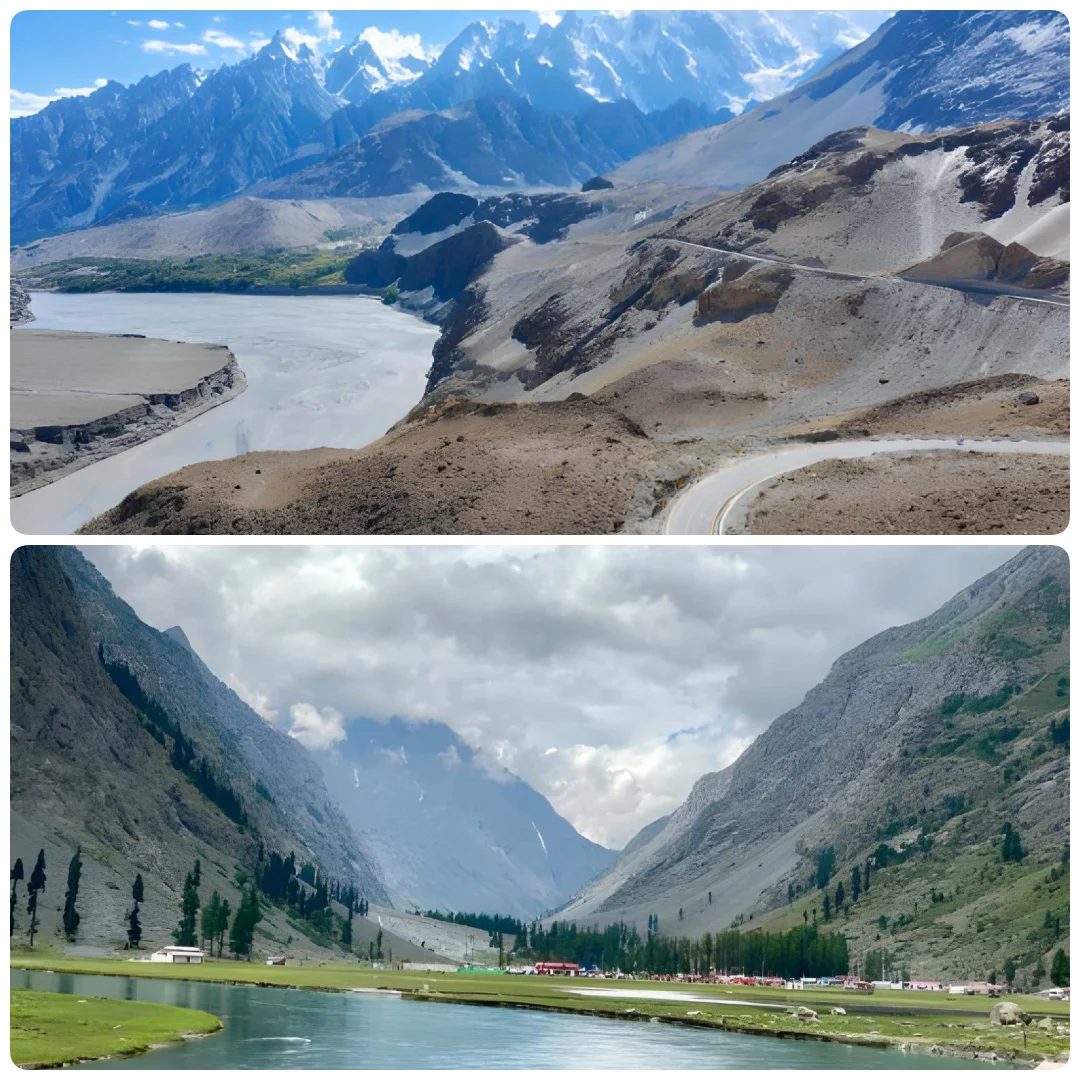
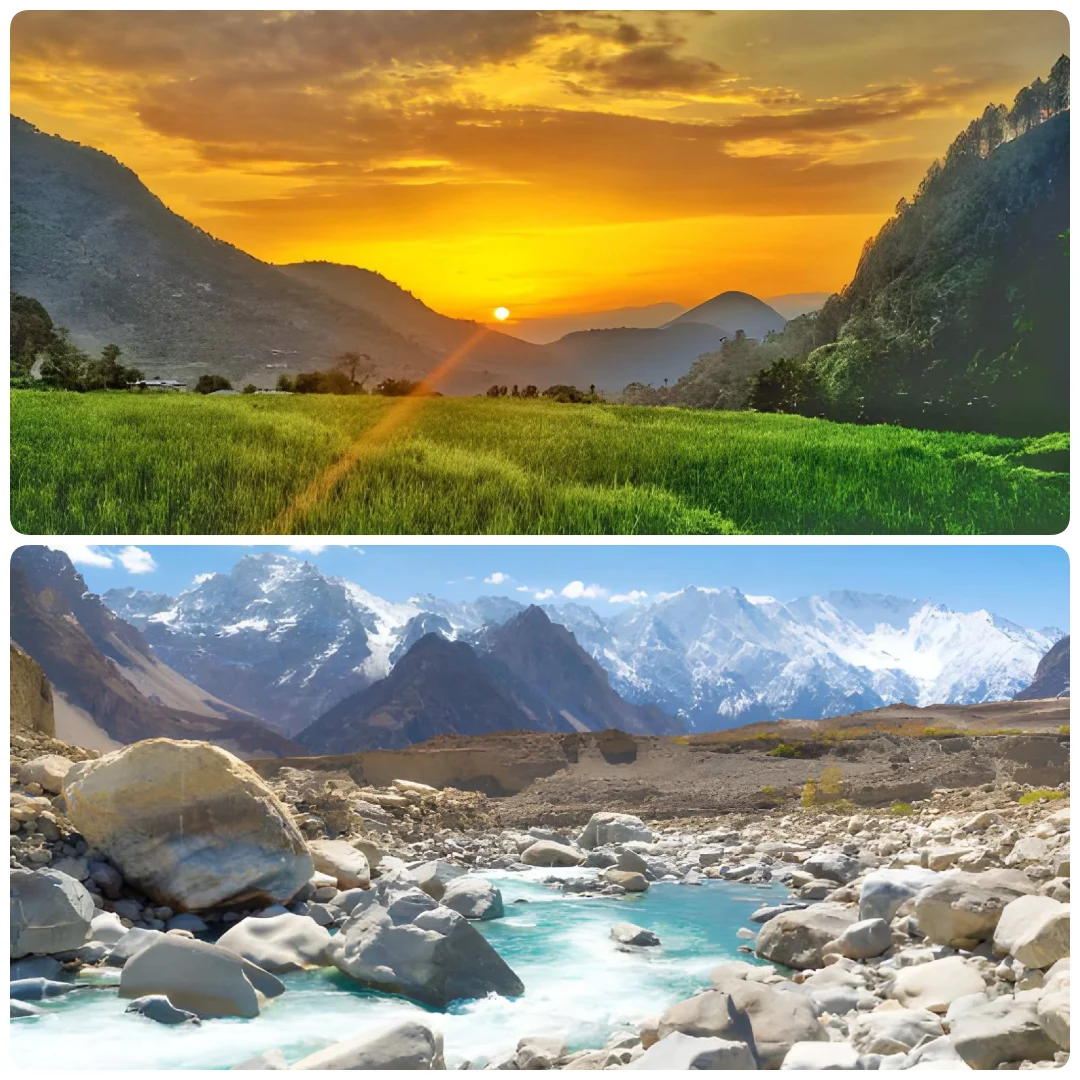
swat-landscape-green-rivers-forests-mahodand.webp
Shot: Swat Valley landscape with pine forests, Swat River, green hills, Kalam meadows, Mahodand Lake route and family travelers near roadside scenery.
Alt: "Swat Valley landscape with green forests rivers Kalam meadows and Mahodand Lake route"
Specs: 1200×900 (4:3) · WebP
Swat’s beauty does not arrive with shock. It arrives with continuity.
You do not cross a single dramatic threshold where the valley suddenly reveals itself. Instead, Swat unfolds gradually — town by town, bend by bend, river stretch by river stretch.
Scenery stays close to you. Pine forests lean into the road. Rivers run beside markets and hotels. Meadows appear without long detours.
You are rarely looking up at Swat. You are moving through it.
Swat’s Landscape: Intimate, Layered and Emotionally Gentle
Swat operates on human scale.
The valley feels inhabited, not conquered. This creates a sense of comfort that many first-time travelers subconsciously need. You do not feel small. You feel included.
Upper Swat areas like Kalam, Ushu and Mahodand introduce alpine drama, but even there the valley maintains softness. The peaks frame the scene rather than dominate it.
Swat’s landscape feels conversational. It allows chatter, chai breaks, short stops and detours without punishment.
Hunza’s Landscape: Monumental, Vertical and Emotionally Intense
hunza-landscape-karakoram-peaks-attabad-passu.webp
Shot: Hunza Valley landscape with Passu Cones, Attabad Lake, Karakoram Highway, rocky mountains, glacier-fed river and dramatic vertical peaks.
Alt: "Hunza Valley landscape with Passu Cones Attabad Lake and dramatic Karakoram mountains"
Specs: 1200×900 (4:3) · WebP
Hunza is different from the first kilometer.
The mountains announce themselves early, and they never let you forget who is in control. In Hunza, the land is not around you. It is above you.
Sheer rock walls rise abruptly. Peaks do not simply frame the road. They overshadow it.
For many travelers, this is intoxicating. For first-timers, it can be overwhelming in ways they do not expect.
Forests vs Rock: Emotional Impact
Swat’s forests create psychological safety. Trees soften sound, absorb wind and reduce visual fatigue. Even when weather shifts, forests make the environment feel protected.
Hunza’s exposed terrain does the opposite. Wind feels sharper. Sun feels harsher. Weather changes feel immediate. There is beauty in that rawness, but it demands emotional readiness.
Many first-time travelers do not realize how much landscape texture affects mood.
Swat calms. Hunza challenges.
Lakes, Rivers and Water Presence
Water is where Swat quietly wins for many first-time travelers.
Rivers in Swat are companions. They run beside roads, restaurants, hotels and picnic spots. You hear water constantly, and it becomes background music.
Lakes in Swat, like Mahodand and Kundol, feel reachable. Even when trekking is required, the journey feels approachable.
Hunza’s water features are fewer but grander. Attabad Lake is stunning, but it is a focal point rather than a rhythm. Glacial streams are powerful but more distant. Rivers cut deep gorges rather than inviting casual pauses.
Choose Swat If You Want
- Green forests, rivers and waterfalls close to the road.
- Scenery that feels welcoming and easy to enjoy.
- More usable photos without advanced photography planning.
- Comfortable family stops and flexible picnic-style pauses.
- A landscape that feels soft, lived-in and emotionally sustainable.
Choose Hunza If You Want
- Huge peaks, glaciers, rocky valleys and dramatic scale.
- More intense visual moments and high-altitude landscapes.
- Photography that rewards timing and patience.
- Awe, silence and the feeling of being surrounded by giants.
- A landscape that challenges rather than comforts.
Culture, People and Daily Life
Landscape may pull you in, but culture is what decides whether a place feels welcoming or merely impressive.
For first-time travelers, this section matters more than most people admit. Mountains can be admired from a distance. People cannot.
How locals interact with you, how comfortable you feel asking questions, how easily you blend into daily rhythms and how naturally help arrives shape memory far more than scenery.
Swat’s Culture: Lived-In, Expressive and Social
Swat feels alive in a way first-time travelers immediately recognize.
Markets are active. Tea stalls are full. Children move between shops. Elders sit in visible clusters, watching the day pass. Life does not pause for tourism — tourism folds into life.
This matters because it lowers the psychological barrier for newcomers.
In Swat, you do not feel like an observer. You feel like a participant, even when you do not intend to.
Swati hospitality is verbal and immediate. People ask where you are from. They comment on the weather. They suggest routes, food and shortcuts, often warmly and casually.
For first-time travelers, this creates reassurance. You are not left guessing. Help often arrives before you ask.
swat-culture-markets-tea-hospitality-family-travel.webp
Shot: Swat cultural scene with lively market, tea stall, local family picnic, trout restaurant, shopkeepers and travelers interacting warmly.
Alt: "Swat Valley culture with markets tea stalls local hospitality and family travel"
Specs: 1200×900 (4:3) · WebP
Hunza’s Culture: Quiet, Observant and Deeply Rooted
Hunza’s culture is not distant, but it is more reserved.
People are polite, articulate and respectful. Conversations are thoughtful rather than spontaneous. Hospitality exists, but it unfolds gradually.
For first-time travelers used to expressive warmth, Hunza can feel emotionally quiet at first. This is often misread as coldness. It is not.
Hunza’s culture values space, self-sufficiency and measured interaction. Once you engage sincerely, warmth runs deep, but it does not rush toward you.
Language, Public Spaces and Family Comfort
In Swat, Pashto dominates daily life, but Urdu is widely understood and used casually. Communication feels fluid. You can navigate markets, hotels and transport without feeling linguistically stranded.
Hunza is more linguistically layered, with Burushaski, Wakhi, Shina, Urdu and English appearing in different settings. English proficiency is often strong in hospitality spaces, but the social energy may feel quieter.
Swat’s public spaces are animated. Riversides double as picnic grounds. Streets are communal. Tourist spots feel integrated into local routines.
Hunza’s public spaces are calmer and more segmented. Viewpoints, cafés and hotels often feel intentionally designed for visitors, while local daily life feels slightly adjacent rather than overlapping.
For families with children, Swat often feels easier immediately. Hunza can feel more serene, but it usually rewards a slower adjustment.
Food Culture and Shared Experience
Food in Swat is social. Chapli kebab, trout, makai roti, tea and roadside meals are eaten in settings that invite conversation. Restaurants often feel like extensions of the street.
Eating in Swat rarely feels transactional.
Hunza’s food culture is quieter and more intentional. Hunza bread, walnut soup, apricot-based foods and lodge-style meals reflect local identity, self-reliance and careful presentation.
Hunza meals feel reflective. Swat meals feel communal.
Cost, Accommodation and Value
When people ask whether Swat is cheaper than Hunza, they are usually asking the wrong question.
The real question is: where do first-time travelers feel in control of their spending?
Cost is not just about numbers. It is about predictability, flexibility and how often small decisions quietly push your budget off course.
This is where Swat Valley and Hunza Valley separate very clearly.
Why Swat Feels Easier on Budget
Swat feels affordable not because everything is cheap, but because costs scale gradually.
You can start modest and upgrade selectively. If one hotel feels overpriced, another is usually a few minutes away. If food prices rise in one area, you adjust without reworking your entire plan.
First-time travelers rarely budget perfectly. Swat absorbs that imperfection.
Hunza does not absorb it as easily. In Hunza, accommodation, transport and food decisions compound. One expensive choice often locks in the next. This does not mean Hunza is unfairly expensive. It means it operates at a higher baseline.
Accommodation Reality: Choice vs Commitment
In Swat, accommodation feels abundant. Mingora, Madyan, Bahrain and Kalam offer budget hotels, mid-range family stays and higher-end resorts. Prices fluctuate, but alternatives exist.
If a hotel does not feel right, you can usually change it without much stress.
Hunza is different. Accommodation clusters around key towns like Karimabad, Gulmit and Passu. During peak season, rooms can be limited and often need pre-booking. Once you commit, flexibility drops sharply.
For first-time travelers, this creates pressure. You are less likely to experiment and more likely to accept pricing because alternatives are limited.
swat-vs-hunza-budget-accommodation-value-comparison.webp
Shot: Comparison graphic showing Swat with more hotel flexibility and local food options, and Hunza with premium view-based stays and longer transport costs.
Alt: "Swat vs Hunza budget accommodation and travel value comparison"
Specs: 1200×900 (4:3) · WebP
Food Costs and Daily Spend
Food is where Swat quietly wins.
Local meals are filling, familiar and consistent. You can eat well without planning. Riverside restaurants, roadside dhabas and hotel kitchens generally operate within reasonable pricing expectations.
Hunza’s food scene is more curated. Meals are often served in cafés or lodges that cater to travelers. Ingredients are local, but preparation and presentation can raise costs. Portions and menus may also feel different from what domestic first-time travelers expect.
Many travelers do not notice the difference on day one. By day four or five, they do.
Transport and Hidden Costs
In Swat, transport costs are easier to understand. Road distances are shorter. Jeep hires are common and more standardized. You can move between towns without restructuring your entire budget.
Hunza’s distances are deceptive. What looks nearby on a map may require fuel-intensive drives, guided transport or extra time. Jeep hires become essential for side trips, and small add-ons accumulate quickly.
This is where many first-time travelers overspend in Hunza, not through one big mistake but through quiet increments.
| Cost Factor | Swat Valley | Hunza Valley | First-Time Impact |
|---|---|---|---|
| Accommodation | More flexible across towns and budgets | More premium and booking-sensitive | Swat gives more control |
| Food | Filling, familiar and easier to budget | Curated, scenic and often higher baseline | Swat feels more economical day to day |
| Transport | Shorter distances and clearer costs | Longer routes and more side-trip costs | Hunza needs tighter planning |
| Independent Travel | Forgiving and flexible | Possible but costlier when mistakes happen | Swat suits beginners better |
| Package Travel | Adds comfort | Often improves efficiency | Hunza benefits more from structure |
Adventure, Safety and Infrastructure
By now, the differences between Swat Valley and Hunza Valley should feel less theoretical and more personal.
This section is about action: not which valley is better, but which valley fits your energy level, comfort zone, travel style and expectations as a first-time visitor to northern Pakistan.
Adventure: Effort vs Reward
Adventure in Swat is accessible.
You do not need technical gear, altitude acclimatization plans or long travel days to feel like you are doing something meaningful. Jeep safaris, chairlifts, riverside walks, short hikes and snow activities at Malam Jabba all deliver excitement without physical or logistical strain.
This matters for first-time travelers because adventure does not feel like risk. It feels like play.
Hunza’s adventure profile is different. Activities are fewer, but deeper. Suspension bridges, glacier walks, long hikes and high-altitude viewpoints demand effort and planning. The reward is immense, but it is earned.
For travelers seeking intensity and challenge, Hunza delivers meaning. For travelers seeking joy and ease, Swat delivers momentum.
swat-vs-hunza-adventure-chairlift-jeep-glacier-bridge.webp
Shot: Adventure comparison showing Swat jeep safari, Malam Jabba chairlift and river walks alongside Hunza suspension bridge, glacier trail and Karakoram viewpoint.
Alt: "Swat vs Hunza adventure comparison with jeep safari chairlift glacier walk and suspension bridge"
Specs: 1200×900 (4:3) · WebP
Safety and Infrastructure: Perception vs Reality
Both valleys are safe, but they feel safe in different ways.
Swat benefits from proximity and visibility. Police checkpoints, medical access, populated towns and year-round movement create a sense of reassurance. Even when traveling independently, you rarely feel isolated.
Hunza feels safe because of social cohesion. Communities are disciplined, crime is low and local systems are strong. However, remoteness amplifies consequences. A delayed road, missed booking or vehicle issue feels larger because alternatives are fewer.
First-time travelers often underestimate how much visible infrastructure affects comfort. Swat shows it openly. Hunza assumes you will trust it.
Family Travel vs Solo Exploration
If you are traveling with parents, children or mixed-age groups, Swat usually wins decisively.
Shorter distances, familiar food, medical access and flexible accommodation reduce stress. Activities scale easily. Children can enjoy snow, riversides or chairlift rides while adults relax nearby.
Hunza suits couples, photographers and solo travelers more naturally. The quiet, scale and pacing reward those who can move slowly and deliberately.
Neither valley excludes anyone, but they invite different rhythms.
Swat Is Easier If You Need
- Shorter road days and easier recovery.
- More hotels across multiple towns.
- Family-friendly activities without extreme effort.
- Food and services that feel familiar quickly.
- More visible infrastructure and medical access.
Hunza Is Better If You Want
- Longer, more immersive mountain travel.
- Dramatic landscapes and high-altitude viewpoints.
- Slow travel with fewer spontaneous changes.
- Photography-focused days and scenic lodges.
- A stronger sense of expedition and remoteness.
Sample First-Time Itineraries
The easiest way to understand the difference between Swat and Hunza is to compare what a realistic first-time itinerary feels like.
A Swat trip can feel complete in four days. A Hunza trip usually needs at least seven days to avoid feeling compressed.
Comfortable First Northern Trip
Day 1: Islamabad to Mingora or Malam Jabba. Day 2: Malam Jabba chairlift, zipline or snow activities. Day 3: Madyan, Bahrain and Kalam. Day 4: Ushu Forest, Mahodand Lake in season or scenic return.
This itinerary gives variety without fatigue: forests, rivers, towns, chairlift, culture and lake access depending on season.
Classic Long Northern Journey
Day 1: Islamabad to Naran or Chilas depending on route and season. Day 2: Continue toward Gilgit or Karimabad. Day 3: Karimabad, Baltit or Altit-side exploration. Day 4: Attabad Lake and Gulmit. Day 5: Passu Cones and upper Hunza. Day 6: Khunjerab-side route if conditions allow. Day 7: Return journey begins.
This itinerary is rewarding, but it needs time, pacing and patience.
swat-4-day-vs-hunza-7-day-itinerary-comparison.webp
Shot: Simple itinerary comparison graphic showing Swat as a complete 4-day route and Hunza as a 7-day route with longer travel stages.
Alt: "Swat 4 day itinerary vs Hunza 7 day itinerary comparison for first time travelers"
Specs: 1200×900 (4:3) · WebP
The Honest Final Verdict
If this is your first trip to northern Pakistan, Swat is usually the better starting point.
Not because Hunza is too much, but because Swat teaches you how to travel the north without punishing small mistakes.
You learn pacing, weather awareness, altitude response, budgeting and mountain movement in a more forgiving setting.
Hunza becomes extraordinary when you arrive prepared.
That is why so many experienced travelers follow the same arc: Swat first, Hunza next, then return to both differently.
When Hunza Is the Right First Choice
Hunza makes sense as your first northern trip if you have seven to ten flexible days, are comfortable with long drives, prioritize landscape over comfort and enjoy quiet, introspective travel.
If that sounds like you, Hunza will reward you deeply.
But if you are unsure about timing, road fatigue, budget pressure, family comfort or your stamina for long-distance mountain travel, Swat will almost never disappoint.
When Swat Is the Better First Choice
Swat is the better first choice if you want a confident, smooth and genuinely enjoyable introduction to northern Pakistan.
It works for short breaks, families, first-time snow trips, flexible routes, budget-conscious travelers and people who want nature without exhaustion.
You can visit Swat, learn your mountain travel rhythm, and then plan Hunza with far better expectations later.
Recommended Tours for Swat and Hunza
If you want your first northern trip to feel confident and well-paced, choose a route that respects weather windows, road conditions, family needs and realistic driving days.
3-day-swat-valley-tour-from-lahore-first-time-travelers.webp
Shot: 3 Day Swat Valley Tour from Lahore with family travelers, Malam Jabba, river scenery, green mountains and comfortable first-time route planning.
Alt: "3 day Swat Valley tour from Lahore for first time travelers with mountains culture and nature"
3 Day Swat Valley Tour from Lahore – Mountains, Culture & Nature
Best for first-time travelers who want a short, scenic and family-friendly introduction to northern Pakistan with easier travel comfort.
View Tour10-day-hunza-skardu-guided-tour-northern-pakistan.webp
Shot: Hunza and Skardu guided tour scene with Karakoram Highway, Hunza Valley, Attabad Lake, mountains, cultural stops and comfortable long-route travel.
Alt: "10 day Hunza and Skardu guided tour through northern Pakistan with mountains lakes and culture"
10 Day Hunza & Skardu Guided Tour – Explore Northern Pakistan
Best for travelers who are ready for a longer northern Pakistan journey with dramatic landscapes, mountain culture and deeper travel planning.
View Tour12-day-kalash-swat-peshawar-tour-first-time-north.webp
Shot: Cultural northern Pakistan journey with Swat Valley, Kalash valleys, Peshawar heritage, mountain roads and family-friendly guided travel.
Alt: "12 day Kalash Swat and Peshawar tour with heritage natural beauty and guided northern Pakistan travel"
12 Day Kalash, Swat & Peshawar Tour
Best for travelers who want Swat with a broader cultural journey through northern Pakistan, heritage routes and guided support.
View TourFAQs About Swat vs Hunza for First-Time Travelers
Is Swat or Hunza better for a first trip to northern Pakistan?
Swat is usually better for a first trip because it is closer, easier to reach, more flexible, more family-friendly and less tiring. Hunza is extraordinary, but it usually suits travelers who have more time and are comfortable with long mountain journeys.
Which is more beautiful, Swat or Hunza?
Both are beautiful in different ways. Swat is greener, softer and more intimate, with rivers, forests and accessible valleys. Hunza is more dramatic and monumental, with huge peaks, glaciers, rocky mountains and high-altitude views.
Which is better for families, Swat or Hunza?
Swat is usually better for families because road distances are shorter, food is familiar, hotels are easier to find and activities like Malam Jabba chairlift, riverside stops and Kalam routes can be adjusted for children and elders.
Which destination is cheaper, Swat or Hunza?
Swat usually gives better budget control because accommodation, food and local transport are more flexible. Hunza can still offer excellent value, but costs are often higher due to distance, seasonal demand, scenic hotels and longer route planning.
How many days do I need for Swat vs Hunza?
Swat can feel satisfying in 3 to 4 days. Hunza usually needs at least 7 days for a comfortable first-time trip because the journey is longer and the destination rewards slower pacing.
Which is easier to reach from Islamabad?
Swat is much easier to reach from Islamabad. The journey to Mingora is usually around 5 to 6 hours, while Hunza often requires 15 to 18 hours by road, usually split over multiple days.
Which is better in winter, Swat or Hunza?
Swat is better for most first-time winter travelers because Malam Jabba offers structured snow activities and lower Swat remains accessible. Hunza in winter is more isolated, colder and more demanding.
Should I visit Swat first or Hunza first?
For most travelers, Swat first is the smarter order. It teaches you northern Pakistan travel pacing in a more forgiving setting. Hunza is best enjoyed later when you are ready for longer drives, remote routes and dramatic mountain scale.
Final Thought: Choose the Valley That Meets You Where You Are
Mountains do not impress everyone the same way.
Some inspire awe. Some create belonging.
Your first trip is not about chasing extremes. It is about choosing a valley that meets you where you are.
Swat welcomes you in.
Hunza challenges you upward.
Both will stay with you, but the order matters.
If you want your first northern trip to feel confident, smooth and genuinely enjoyable, start with Swat and do it right. If you already know you are ready for longer drives, remote terrain and dramatic mountain scale, Hunza will reward you deeply.
